
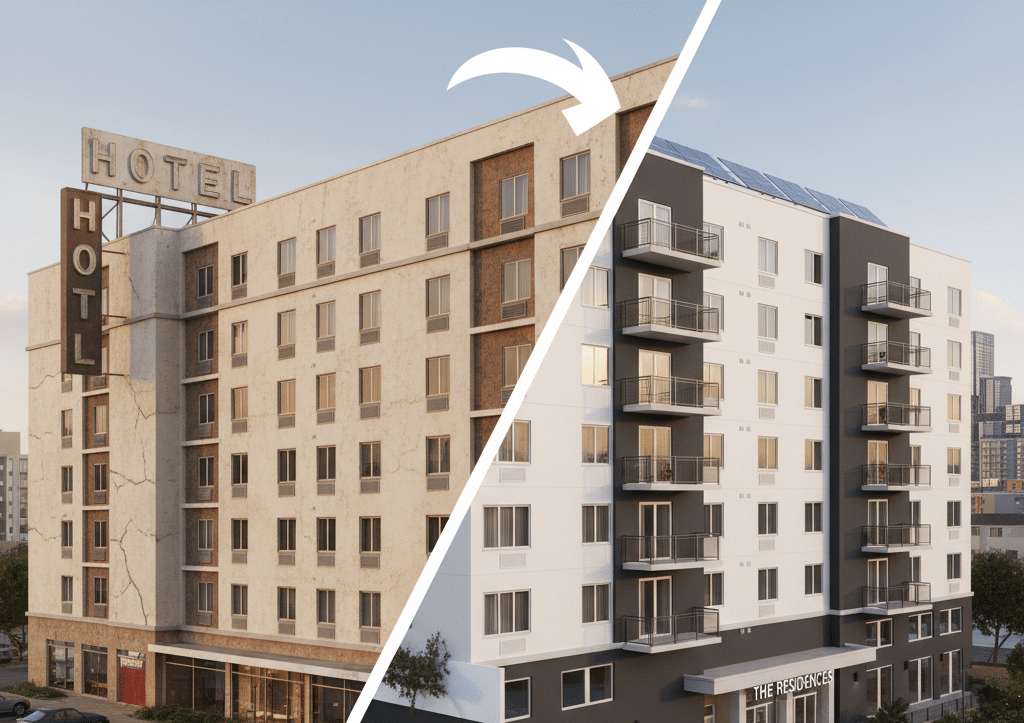
In commercial real estate, the most innovative strategies often come from seeing a problem as an opportunity. Today, two major market forces, a nationwide housing shortage and a shift in the hospitality industry, are creating one such opportunity, i.e., the hotel to multifamily conversion. This specific type of adaptive reuse is basically a logical solution that repurposes underperforming assets to meet a critical community need, offering a promising path for savvy investors.
If you own a hotel that’s no longer performing well, learning the blueprint for a successful conversion could show you how to turn it into a profitable new opportunity.
The Blueprint for a Successful Conversion
Transforming a hotel into apartments involves a detailed strategic plan. The financial feasibility of a hotel to multifamily project hinges on understanding the unique advantages and costs associated with the building’s original design.
While the existing structure, plumbing, and electrical systems offer a significant head start over new construction, several key modifications are necessary to create true residential units. So, a successful conversion typically requires:
- Installing Kitchens:This is the most crucial addition. Every unit needs a functional kitchenette or full kitchen to be considered a viable apartment.
- Reconfiguring Layouts:Hotel rooms are often smaller than typical apartments. This may involve combining two or three rooms to create more spacious one- or two-bedroom units.
- Upgrading Amenities:Lobbies, business centers, and pools need to be reimagined as resident-focused amenities like co-working spaces, tenant lounges, or enhanced fitness centers.
Navigating the Path from Commercial to Residential
In most hotel-to-multifamily conversions, the most significant challenge is often not construction, but compliance. The core issue lies in zoning, since hotels are approved for short-term stays under commercial use, while apartments require residential zoning for long-term tenants.
These zoning issues in hotel conversion projects mean developers must secure a variance or pursue full rezoning before work can begin. That process often takes time and requires a strong grasp of local land-use rules and building codes. Residential properties also face stricter standards for fire safety, accessibility, and utilities than hotels.
Thus, getting this step right early on is critical. It determines whether a project moves smoothly or stalls before it even starts.
Wrap Up
When planned and executed correctly, these projects are powerful investments. Across the country, case studies of hotel to multifamily conversions show underutilized buildings becoming vibrant communities. They bring new housing to the market faster and often more affordably than ground-up developments.
This approach not only generates returns for investors but also revitalizes neighborhoods and helps solve the housing affordability puzzle one property at a time.
A successful conversion requires more than capital; it requires foresight. If you see potential in an underperforming property, the next step is a detailed analysis.
Connect with the experts at Cindy Hopkins Commercial Real Estate to evaluate your opportunity and map out a clear path from hotel to home!



Leave A Comment