
Finish selections are usually treated as a design conversation that happens late in a project, after the deal economics are settled. In commercial property they are a capital decision that gets re-made every lease cycle, and the owner pays for it either way.
The gap between a baseline specification and a high-end one is larger than most owners assume, and it lands squarely on the ownership side of the ledger.
The Specification Gap Is the Size of the TI Allowance
JLL put the average medium-quality office fit-out across the United States and Canada at roughly $295 per square foot in its 2026 guide, ranging from about $255 at baseline to $355 for high-specification work. That is a $100 per square foot spread, much of it material selection.
Set that against what owners contribute. CBRE analyzed 4,350 new office leases across 12 markets and found tenant improvement allowances averaging $87.51 per square foot in 2024, down from a 2023 peak of $97.55 but still roughly 30 percent above pre-pandemic levels.
Read those two numbers together and the picture is clear. The spread between a cheap finish package and an expensive one is roughly the size of the entire allowance the owner is already funding. That makes commercial interior design a material line in the deal rather than a decorating exercise that happens afterward.
Flight to Quality Is a Materials Story
The divergence between good buildings and average ones is now measurable. Cushman & Wakefield reported overall U.S. office vacancy at 20.1 percent in the second quarter of 2026, with the national average asking rent at $38.38 per square foot against $44.17 for Class A space.
The absorption numbers are starker. The overall market posted negative net absorption of 360,000 square feet in the quarter while Class A absorbed a positive 4.4 million. Class A recorded positive absorption in 60 of 92 tracked markets.
Tenants are not leaving the market. They are consolidating into better space, and specification is a substantial part of what makes it better. Owners weighing office upgrades against tenant retention are running the same calculation from the other direction.
One caution on the quality premium. CBRE compared roughly 2,800 LEED-certified U.S. office buildings against 17,700 non-certified comparables and found an unadjusted rent premium of 31 percent. After controlling for age, size, renovation history and location, that premium fell to 3.7 percent. The gap between those figures is the useful finding: most of the headline green premium is measuring that certified buildings tend to be newer, larger and downtown. A real premium survives the controls, but it is an order of magnitude smaller than the number in most marketing decks.
Specify for the Hold Period, Not the Fiscal Year
The standards world has a framework for this. ASTM E917 sets out the practice for measuring life-cycle costs of buildings, and NIST Handbook 135 is the federal manual for applying it. Both frame the question the same way: the relevant number is the total cost of owning and operating over a defined study period, not the invoice at installation.
Service life makes that concrete. Fannie Mae’s capital needs assessment tables, used in underwriting, put common-area finishes at very different lifespans:
- carpet at roughly 5 years, which is about one lease cycle
- resilient tile and sheet flooring at roughly 15 years
- ceramic tile, quarry tile and terrazzo at 50 years or more
- concrete at 50 years or more
Those are multifamily underwriting assumptions rather than office figures, so treat them as directional. The direction is decisive anyway. Over a ten-year hold, common-area carpet is replaced twice and terrazzo is replaced never, which makes choosing durable and innovative materials a cash flow decision disguised as an aesthetic one.
Where Marble Earns Its Place, and Where It Becomes an Operating Expense
Natural stone does real leasing work in a lobby. It also carries a maintenance obligation that behaves differently in a commercial building than in a house.
The Natural Stone Institute is direct about marble’s chemistry. The calcite that gives marble its character is vulnerable to mild acids, including those commonly found in kitchen and bar settings, and sealing does not solve it. An impregnating sealer blocks absorption, which addresses staining. Etching happens at the surface a sealer is not covering, and the damage is permanent rather than cleanable.
In a private residence the owner controls the cleaning products. In a commercial building the owner does not. A contracted janitorial crew works a fixed nightly route with a standard chemical caddy, and commercial restroom and bar cleaners are frequently acidic descalers or high-alkaline degreasers.
That makes neutral-pH cleaning a procurement question rather than a housekeeping one. If it is not written into the janitorial scope of work, the specification will not hold. So marble countertops in a lobby pantry, bar or restroom are not a finish decision, they are a recurring obligation the owner takes on behalf of every tenant, guest and subcontractor who will ever touch them.
Marble on vertical and low-contact surfaces is a different proposition. Feature walls, reception fascias and elevator lobby cladding get the perceived-value return without the acid exposure, and that is where the material genuinely pays.
What Interior Plants Actually Do
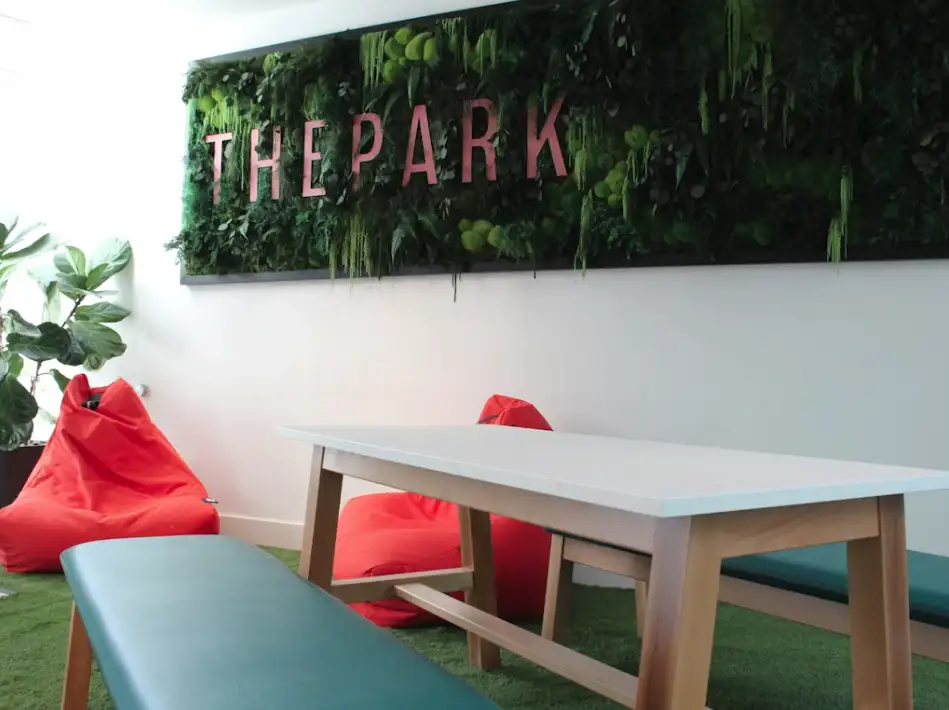
Interior planting is worth specifying, but not for the reason it is usually sold.
The claim that indoor plants purify the air traces to a 1989 NASA study run in small sealed chambers with no air exchange. A 2020 peer-reviewed reanalysis in the Journal of Exposure Science and Environmental Epidemiology recalculated the literature using clean air delivery rate and found the median single plant delivers about 0.023 cubic metres per hour. Matching what ordinary building ventilation already achieves would take somewhere between 10 and 1,000 plants per square metre of floor area. The plants are not failing, they are being outperformed by the HVAC system by orders of magnitude.
What the research does support is perception. Field experiments have found higher workplace satisfaction and better perceived comfort in planted offices, though the one study measuring objective call-centre productivity found no effect. That is still commercially useful in a leasing context. It is simply not an air quality claim.
There is one checkable certification reason. WELL v2 awards points where potted plants cover at least 1 percent of floor area per floor, or a plant wall covers at least 2 percent, as an optimization rather than a requirement. LEED awards nothing for interior plants, since its views credit concerns views to the outdoors. Owners pursuing sustainability certifications and lease values should know which credits interior planting actually touches.
The economic reality is that interior landscaping design is a recurring service contract rather than a capital item. Neglected planting becomes a visible negative signal in exactly the lobbies and amenity floors where the material spend was supposed to be working hardest.
The Specifications That Carry Liability
Three numbers belong in any commercial finish package, and they are the ones most likely to be missing.
- Slip resistance. ANSI A326.3 sets a minimum dynamic coefficient of friction of 0.42 for level interior spaces expected to be walked on when wet. Note that the 2022 revision replaced the single threshold with five situation-specific minimums, and that the standard itself states the test does not predict whether a person will slip. Note also that ASTM C1028, the old static test, was withdrawn in 2014, so any datasheet still citing it is citing a method retired twelve years ago.
- Abrasion resistance. The Natural Stone Institute recommends a minimum ASTM C241 abrasion index of 10 for marble and limestone, 12 in heavy traffic areas, 8 for slate, and 25 for granite. These are specification floors rather than a ranking between stone types.
- Accessibility. The 2010 ADA Standards require floor surfaces to be stable, firm and slip resistant, cap carpet pile height at half an inch, and require changes in level between a quarter inch and half an inch to be beveled.
Worth knowing that the ADA requires slip resistance without specifying a number. The number comes from ANSI, not the ADA, and the two are routinely conflated.
Be Mindful When Choosing Materials
Material selection is underwritten over a hold period, not a fiscal year. Finishes that survive a lease cycle reduce the capital you re-spend at turnover, ones needing specialist maintenance become a line in the operating budget, and the specifications that carry liability are the cheapest thing in the package to get right.
Owners getting the most from a renovation budget treat the finish schedule as an underwriting document rather than a mood board, and interior design decisions for a commercial space deserve that scrutiny early, while changes are still cheap.
At Cindy Hopkins Commercial Real Estate (CHRE), we help property owners and investors evaluate assets with an eye on what the building will cost to hold, not just what it costs to acquire. Contact us today to talk through your property.
Author Bio:
Sam Willis is a freelance writer that loves sharing his knowledge and expertise in engineering, construction, and business. He lives in Atlanta, Georgia where he enjoys spending time with his wife and family in his free time. Sam’s work as a freelance writer can be found on Building Product Advisor, a construction industry resource site.



Leave A Comment