
For facility managers, asset managers, and owners responsible for commercial property management, the daily challenge is keeping costs predictable while tenants expect consistent comfort and reliability. Energy waste, avoidable alarms, and scattered controls quietly erode energy efficiency, strain staff time, and put operational uptime at risk. Building automation systems address that tension by turning building operations into a coordinated, measurable set of decisions instead of disconnected manual adjustments. The payoff is steadier performance that supports tenant comfort.
Understanding How a BAS Actually Works
A building automation system is a stack of connected parts that sense conditions, make decisions, and act on equipment. At the edge, sensors and controllers read temperatures, CO2, occupancy, and light levels, then open dampers, stage compressors, or dim fixtures. Those controllers share data over a network, while supervisory software provides schedules, setpoints, alarms, trends, and a single place to coordinate priorities across the site.
What makes it effective is the feedback logic that keeps performance on target. In closed-loop control, sensors constantly report results so the system can correct course in real time. BAS integrations also prevent one system from fighting another, like HVAC cooling a space while lighting and plug loads spike.
Think of a busy conference room: occupancy rises, ventilation increases, cooling ramps smoothly, and lights adjust to daylight without staff intervention. The result feels like consistency, even though many small decisions are happening every minute. Clear dashboards at the point of work make those decisions visible and actionable.
Choose a Rugged Touchscreen Operator Panel for On-Site Control
Once the BAS logic and network connections are in place, day-to-day performance often comes down to how easily staff can see status and make adjustments on site. Rugged touchscreen control panels give building engineers a dependable, local interface for monitoring and tuning connected building systems, especially in mechanical rooms or at security desks where consumer-grade hardware can be a weak link. A rugged panel computer with durable performance pairs industrial computing with an integrated touchscreen so the BAS dashboard and control tools live in a single, all-in-one human-machine interface.
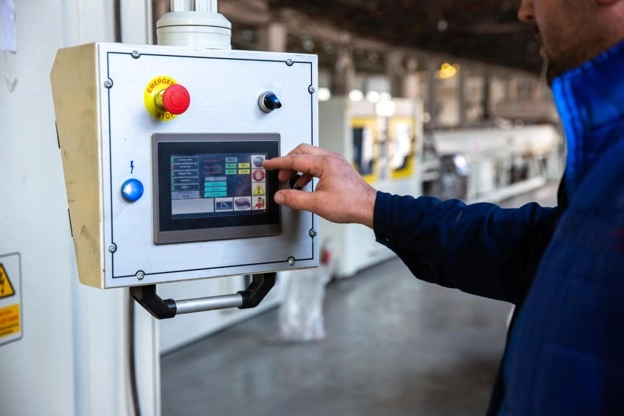
Image via Magnific
For example, the Tacton industrial panel PC line is built for manufacturing, automation, and warehousing and logistics environments, with fanless, ventless cooling to reduce failure points and maintenance headaches. It also adds an IP66/IP69K-rated front bezel to stand up to demanding conditions, and it’s rated to operate from -20°C to 70°C for spaces that swing hot or cold. Because these panels use a modular design with a wide range of I/O options, they can be configured to fit demanding industrial workflows without forcing a one-size-fits-all setup.
BAS Payback Paths Compared
This table benchmarks common BAS rollout approaches by the types of savings they usually unlock and the cost drivers that influence payback. Use it to pressure-test where your biggest gains are likely to come from: energy reduction, staff time, or fewer disruptions.
| Option | Benefit | Best For | Consideration |
| Schedule optimization and setpoint tuning | Lower HVAC runtime with minimal disruption | Buildings with stable occupancy patterns | Savings depend on consistent enforcement and review |
| Sensor-driven HVAC control (occupancy, CO2) | Better comfort with reduced over-ventilation | Variable-use floors and meeting-heavy spaces | Requires sensor upkeep and calibration planning |
| Centralized fault detection and analytics | Faster issue discovery and fewer callbacks | Sites with recurring comfort complaints | Needs clean data and defined triage workflows |
| Standardized on-site operator interface | Quicker adjustments and fewer mis-operations | Multi-shift teams and distributed assets | Hardware lifecycle and spares strategy matter |
| Phased integration of legacy equipment | Spreads capital cost and limits downtime | Older properties with mixed vendors | Integration complexity can raise engineering effort |
If budgets are tight, start with tuning and scheduling to validate process and governance. When comfort tickets and after-hours labor are the pain point, analytics and better local control often justify the effort through uptime and productivity improvements. Knowing which option fits best makes your next move clear.

Image via Magnific
BAS Rollout FAQs: Integration, Security, and Support
Q: What if our building has mixed, older equipment?
A: A BAS can still work, but you need a clear inventory of controllers, protocols, and points you want to monitor or command. Plan for gateways or staged controller upgrades where integration is unreliable. Ask the integrator to prove connectivity on a small pilot area before scaling.
Q: How do we reduce cybersecurity risk with a connected BAS?
A: Treat the BAS like an IT system, with network segmentation, strong authentication, patching, and audited remote access. Rising threat activity is real, including a 20% increase in cyber-attacks on critical infrastructure in 2023. Require a written security plan and incident response contacts in the contract.
Q: What maintenance keeps comfort gains from fading over time?
A: Assign ownership for setpoints, schedules, and alarm rules, then review trend data monthly. Calibrate sensors on a defined cadence and replace drift-prone devices proactively. Keep a change log so overrides do not become permanent.
Q: How do we avoid buying software features we never use?
A: Start with a shortlist of operator workflows, then map each feature to a real task. Facility teams can get burned by applications without a plan that add cost without reducing calls. Insist on role-based training and acceptance tests tied to those workflows.
Q: What should we look for when selecting a BAS vendor or integrator?
A: Prioritize open standards support, documented commissioning, and clear service level commitments for response times and parts. Ask for references in similar building types and request a sample sequence of operations, not just a demo. Make sure you own your data and have a path for future expansion.
Measure BAS Impact with Metrics That Protect Comfort and Cost
Commercial buildings face a constant tradeoff: cutting energy use without creating comfort complaints or operational risk. The most reliable way forward is to treat BAS decisions as a cost-benefit analysis grounded in BAS evaluation metrics, not features, and to weigh property-specific considerations like equipment age, occupancy patterns, and critical zones alongside energy management strategies. Done well, BAS becomes a management layer that stabilizes performance, supports tenant satisfaction improvements, and reduces surprises over time. If it can’t be measured in outcomes, it can’t be managed in automation.



Leave A Comment